
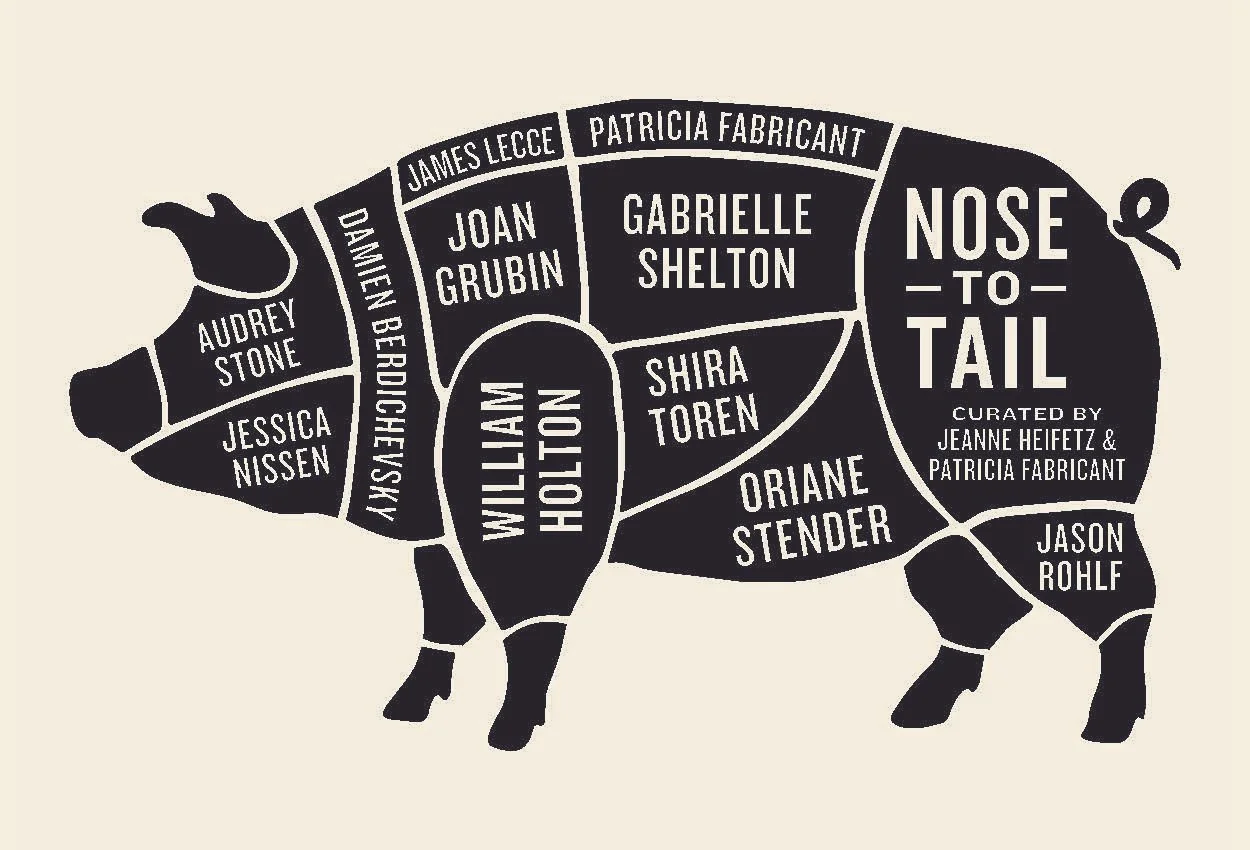
Nose to Tail
June 11 – July 11, 2026
Equity Gallery
Opening Reception: Thursday, June 11, 6:00–8:00 PM
As inflation ticks ever higher and resources more precious, curators Patricia Fabricant and Jeanne Heifetz offer a timely and prudent exploration of thrift with Nose to Tail, a group show featuring artworks sourced from studio process by-products, down-time doodles, and happy accidents.
Exemplifying a virtuous “let nothing in the studio go to waste” theme, the show’s cohort includes:
Damien Berdichevsky, Patricia Fabricant, Joan Grubin, William Holton, James Lecce, Jessica Nissen, Jason Rohlf, Gabrielle Shelton, Oriane Stender, Audrey Stone, Shira Toren
Fabricant and Heifetz note, “Nose to Tail celebrates the generative possibilities of the decision to let nothing in the studio go to waste. The artists in the show repurpose studio materials that serve a practical function, or the outtakes and offcuts from other works, finding sustenance in happy accidents that become artworks in their own right.” For example, Damien Berdichevsky’s habit of wiping paint from spatulas and brushes onto the pages of a discarded issue of The Brooklyn Rail subsequently (and unintentionally) evolved into a page-tuner of chance compositions christened The Book of the Comfort Zone. Jason Rohlf’s muslin clean-up rags, smeared with a day’s worth of color, act as giornatas, documenting discrete sections of paintings in progress. Coated with gel medium and pressed against an aluminum painted rooftop, they harden into reliefs, their chance marks, dents and protrusions a map for further painterly interventions.
Audrey Stone likewise employs paint-stained dishtowels, napkins, and household rags as substrates, exploiting (as reportedly did Leonardo) happenstance blotches as starting points for lyrical compositions.
Everyday paint splatters and dried-out palettes are studio givens. Joan Grubin removes the veneer of her AbEx activated studio tabletops, cutting and reassembling the wood into intimate marquetry sculptures. For her loom-based works, Oriane Stender uses blotter paper to catch the stray paint applied to threads during the initial weaving stages—creating accidental ‘ghost prints’ as compelling as the finished weavings.
James Lecce loves peeling dried layers of paint from containers; it’s a lot more fun than scrubbing, and those drippy, flexible, easy on the eyes color-forms become the raw material for naïve sculptures documenting 25 years of color mixing strategies. Jessica Nissen likewise cherishes the pile-up of residual paint from a day’s work; these bits have culminated in a parallel series of invented landscapes, worked on while contemplating next steps on larger works.
William Holton’s color studies, comprising rapid gestural strokes on test surfaces (often using residue pigments extracted from solvent wells) offer chromatic experiments as an expressive counterpoint, and hard to fathom surrogate, to his polished abstractions.
Waste not, want not; metal fabricator Gabrielle Shelton turns the offcuts of her high-end stair and ladder designs into small-scale narrative sculptures free of the burden of codes, contractors, and clients. Shira Toren uses painter’s tape to create defined edges and geometric patterns in her large-scale paintings. Once the painting is complete, she removes the tape, now imbued with vibrant paint residue, and repurposes it in colorful collages on paper. Ending up with leftover strips from her woven self-portrait series, Patricia Fabricant accumulatedenough strips to create a new body of work. Paradoxically, she came to like the new series so much, she found herself making the self-portraits simply in order to generate scraps.